
22 Jul Strength Training vs. Group Classes: Which Is the Best Workout for Women Over 40?
A year and a half ago, my client (now girlfriend) Tiffany came to me with low back pain, low energy, and a body that felt like it had stopped listening to her. We built her back up with deadlifts, lots of rotational and anti-rotational exercises, and overall just some good old-fashioned strength training. A few months in, she took the trash out, ran up a flight of stairs without thinking about it, and stopped in her tracks.
“Oh my gosh,” she said. “I have so much energy.”
Fast forward a year. She joined a friend for a month of high-energy barre classes, the kind marketed as the answer to fitness after 40. By the end of that month, she was wiped out. Bloated. Foggy. Wondering what was wrong with her.
Nothing was wrong with her. She’d just run headfirst into one of the biggest misunderstandings in women’s fitness: the best workout for women over 40 isn’t the one that leaves you most exhausted, it’s the one that makes you strong.
If you’re a woman in your 40s or 50s trying to figure out whether you should be chasing your next class pass or picking up a barbell, this one’s for you.
The Problem With How Most Women Over 40 Are Taught to Exercise
Here’s the pattern I see over and over with new clients, especially women: they were taught that fitness means sweating, burning calories, and feeling wrecked afterward. So they join barre classes, bootcamps, spin studios, high-energy, high-intensity, community-driven group fitness. And to be clear, there is nothing wrong with any of that on its own. There’s real value in community, in showing up, in moving your body around other people who cheer you on.
The problem is what happens when that becomes the only thing you do, three or four times a week, for years.
Group fitness studios are built on a business model that depends on packed classes and long-term memberships. That’s not a criticism, it’s just reality. Most boutique studios keep customers by offering the same style of workout, session after session, dressed up in different playlists and themes. And metabolic, high-intensity formats like this deliver real results in the beginning: more energy, sometimes there is visible fat loss, and usually better cardiovascular fitness. Research bears that out; one industry-cited North American Menopause Society study found HIIT to be both safe and effective for women over 40, even outperforming steady-state cardio for fat loss.
But your body isn’t static, and neither are your hormones. Once you push into your 40s and toward perimenopause, the calculus changes.
Why Constant High-Intensity Classes Backfire After 40
This is the part nobody explains at check-in.
Every hard class you take spikes your cortisol; that’s completely normal. A single HIIT session, one industry source notes, elevates cortisol for up to about two hours afterward, which isn’t a problem in isolation. The issue is frequency and recovery. When you stack that same intensity three, four, five days a week, on top of a normal week of work stress, parenting, and everyday anxiety, you’re not giving your system time to come back down.
During your reproductive years, estrogen does a lot of quiet work behind the scenes regulating your stress-hormone system. It helps your body clear cortisol efficiently and keeps your stress response on a healthy rhythm. As estrogen naturally declines through your 40s and into perimenopause, that buffering effect fades. The same workout that used to leave you energized can start leaving you flattened.
Left unmanaged, this pattern edges toward something exercise physiologists actually have a name for: overtraining syndrome, a state marked by chronically elevated morning cortisol, poor recovery, higher injury risk, and, ironically, worse versions of the very symptoms women are trying to train away, including fatigue and stubborn fat gain.
This isn’t just a women’s fitness issue, either. I’m a distance runner. I’ve watched the same thing happen to runners who never vary their training, same pace, same mileage, same pattern, year after year. Eventually the body just breaks down in some form. Most people never connect the dots, because life usually intervenes first: an injury, a baby, a move, burnout. They just quietly stop and never learn why.
What This Actually Feels Like
If you’ve been living in back-to-back barre classes, HIIT circuits, or bootcamps for a while, some of this might sound familiar:
- Waking up tired no matter how much you slept
- Feeling puffy or bloated for no clear reason
- Plateauing, or backsliding, despite “working out hard” consistently
- Getting more sore, more often, and taking longer to bounce back
- Low motivation that feels like laziness but isn’t
That was Tiffany’s exact experience after her month of barre classes. Not because barre classes are bad. Because that was the only thing she was doing, at a volume her 40-something hormonal system couldn’t recover from.
So What Should Women Over 40 Actually Be Doing?
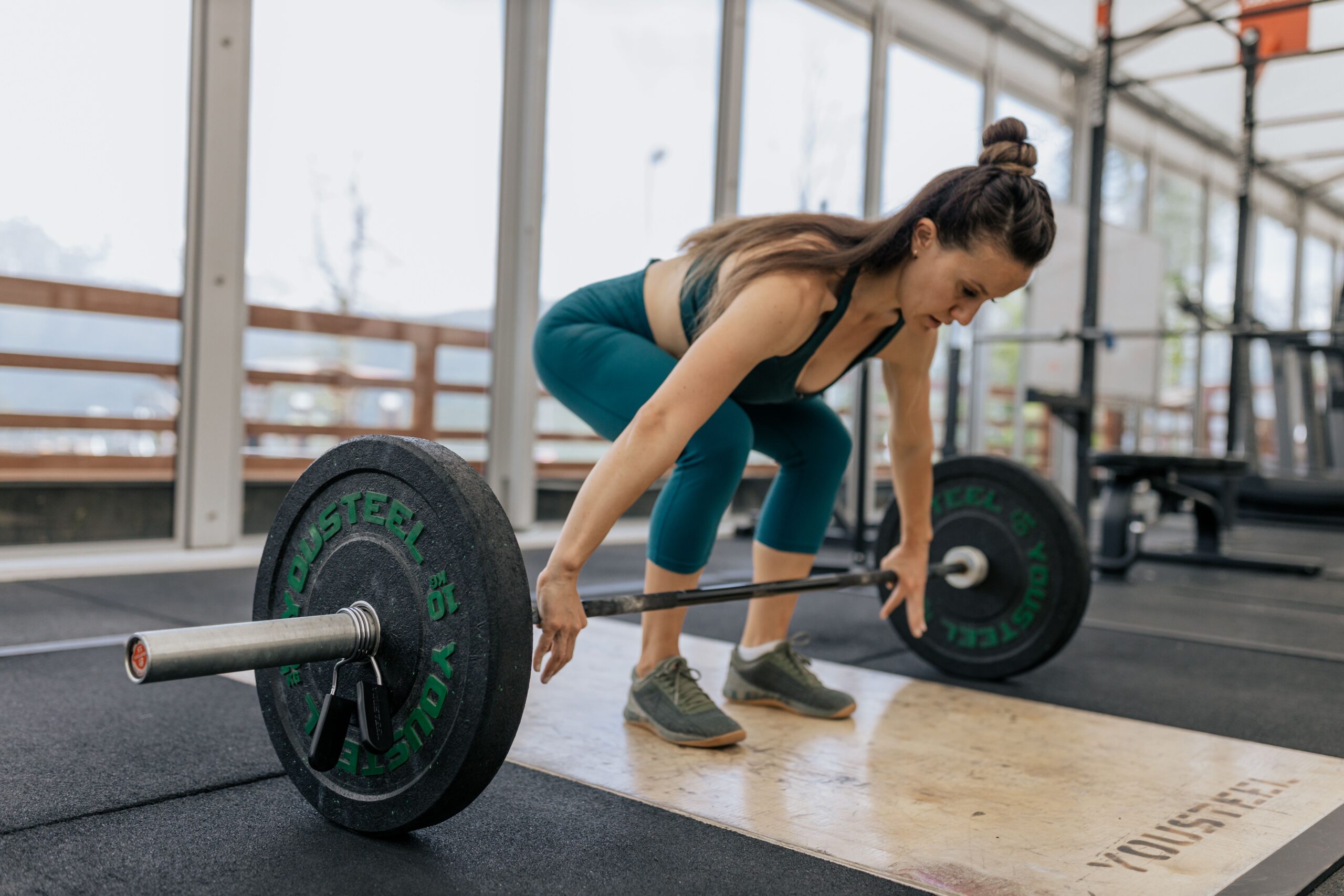
Strength training. Not as a supplement to your cardio. As the foundation everything else sits on top of. Real strength training. Oftentimes heavy. Relatively of course.
This isn’t just my opinion from 15 years of coaching, the research backs it up hard, and it’s not close.
Strength training protects your bones when nothing else will. One of the most cited trials in this space, the LIFTMOR study out of the Journal of Bone and Mineral Research, put postmenopausal women through eight months of heavy squats, deadlifts, and overhead presses at high loads. The training group saw meaningful gains in spinal and hip bone density, while the non-training group actually lost bone density over the same period. Other systematic reviews of postmenopausal women point to a similar sweet spot: moderate to heavy loads, two to three sessions a week, done consistently over months, not weeks.
Strength training is the direct counter to cortisol-driven muscle loss. Chronic high cortisol actively breaks down muscle protein; one widely cited study found it can reduce muscle protein synthesis by roughly 20% within days. Resistance training is one of the few tools that pushes back against that directly, which is part of why fitness researchers increasingly describe strength work as “non-negotiable” for women in perimenopause, not optional.
Strength training doesn’t hijack your hormones the way nonstop high-intensity cardio can. You still need to work hard; heavy strength work is genuinely demanding. But it doesn’t carry the same repeated cortisol-spike-and-never-fully-recover pattern that back-to-back HIIT classes create when they’re your only form of exercise.
Strength training builds the kind of strength that shows up in real life, the strength that lets you run up a flight of stairs without thinking about it, carry groceries in one trip, get off the floor without using your hands, and stay independent decades from now.
Group Classes vs. Strength Training: The Honest Comparison
| Group / HIIT-Style Classes | Structured Strength Training | |
| Best for | Cardiovascular conditioning, community, motivation, fun | Bone density, lean muscle, hormonal resilience, functional strength |
| Cortisol impact | Spikes cortisol; fine occasionally, risky at high frequency after 40 | Demanding but doesn’t carry the same chronic cortisol load |
| Progression | Often the same format week after week; hard to track true progress | Progressive overload, you can measure and build strength over time without bulking |
| Bone health | Minimal direct impact | Strongest evidence-based tool for building or preserving bone density |
| Ideal frequency after 40 | 1 to 2x per week, as a complement | 2 to 3x per week, as the foundation |
| Risk if overdone | Overtraining syndrome, fatigue, plateaus, injury | Low, when loads are appropriate and recovery is built in |
Notice this isn’t “classes are bad.” It’s about what’s carrying the load in your week. Classes make a great addition. They make a rough foundation.
What “Lifting Heavy” Actually Means
When I say strength training, I don’t mean two 10-pound dumbbells and forty reps until your arms burn. That’s a metabolic workout wearing a strength costume. It has its place, but it’s not building the tissue-level strength your joints, tendons, and bones actually need.
Real strength training means:
- Compound lifts, squats, deadlifts, presses, rows, the movements that recruit the most muscle and give you the most return
- Lower rep ranges, think sets of three to six reps at a genuinely challenging weight, not twenty-plus reps at a weight you could do in your sleep
- Progressive overload, gradually adding weight or difficulty over weeks and months, so your body has a reason to keep adapting
- Trained eyes on your form, at least periodically, especially if you’re newer to lifting or coming back after time away
- Variety within the strength category, single-leg work, carries, rotational movements, and some explosive power work like medicine ball throws, which build the tensile strength your tendons need as you age
That’s exactly the framework I used with Tiffany. We didn’t start her deadlifting heavy on day one; she built up to it. But within a few months she was deadlifting 80 to 110 pounds, which was a genuinely big deal for where she started. That’s max-effort strength work, not class-style conditioning.
“Will I Get Bulky?” Let’s Kill This One for Good
This is the question that keeps more women out of the weight room than any other, and I get it. It started with decades of toning-class culture telling women that light weights and high reps were the “safe” way to work out, while heavy lifting was a men’s activity.
Here’s the truth: building visible, significant muscle mass is a slow, deliberate process that requires training four to six days a week, eating well above what most people eat, and often years of dedicated, dense training aimed specifically at that outcome. It’s genuinely difficult to do by accident. Add in the fact that women naturally carry a fraction of the testosterone men do, and the odds of “accidentally” packing on 15 pounds of muscle from a well-rounded strength program are close to zero.
What you actually get from lifting heavy, relative to you, is strength, energy, bone density, and a body that feels capable, not bulky.
A Simple Starting Point
If you’re a woman in your 40s or 50s reading this and wondering where to start, here’s the short version:
- Make strength training your foundation. Two to three sessions a week, built around compound movements. Start with two and go from there. Get consistent first.
- Keep 1 to 2 high-intensity or class-style sessions if you enjoy them. They’re a great complement, not a replacement.
- Get trained eyes on your form, even briefly, before loading up on the big lifts.
- Add variety. Your body and your brain both need new movement patterns, not the same routine on repeat for years.
- Listen to your recovery, not just your motivation. Tired and foggy isn’t a badge of honor; it’s often a sign your training and your recovery are out of balance.
The Real Goal
I don’t do this work because I want people to look a certain way in a mirror. I do it because 15 years ago my own body fell apart, and it taught me more about resilience than anything else in my life ever has. I want the people I train to feel what Tiffany felt running up those stairs: strong, capable, and surprised by their own energy, instead of what she felt after that Bachelorette weekend, wiped out, bloated, and wondering what was wrong with her.
Nothing was wrong with her. She just needed the right foundation. Strength training is that foundation, for her, and for most women over 40 who are ready to stop guessing and start building something real.
If you’re in Colorado Springs and ready to build that foundation with someone who’ll walk beside you, not just hand you a program and disappear, schedule a call with me and let’s talk about where you’re starting from.
No Comments