
13 Mar Core Workouts for Men: Build Strength, Stability, and Better Movement
You feel it when the bar gets heavy, when the trail gets steep, or when you stand up after a long day at a desk. Core workouts for men should not be focused on chasing a six-pack burn, it is building the kind of midsection strength that keeps you solid under load. This guide shows what “core” really means, how to brace, and how to follow a simple plan you can repeat all year.
What “Core” Training Really Means (And Why Men Feel It Fast)
Your core is not just abs.
- It is your whole trunk system that links your shoulders to your hips so you can transfer force without leaking power.
- That includes the rectus abdominis on the front, the obliques on the sides, and the transverse abdominis deeper inside.
- It also includes the spinal erectors along the back, plus the glutes and hip flexors that control pelvic position. Tip to remember: The glutes are the “powerhouse” of the body.
Core training is aimed towards building a body that is resilient through many different facets of life and the ups and downs that life brings. Whether you’re training hard for competitions or just living life, little things will creep up on you and pain is inevitable throughout your life.
That is why it shows up fast in strength training, hiking, and even carrying groceries. For a lot of men, the first win is fewer low back pain flare-ups and less knee pain. A stronger brace and better ribcage stacking help you keep a neutral spine when you hinge, squat, and move through the day.
Posture improves too, but not because you “stand up straight” all the time. It improves because your ribs and hips stop fighting each other, and your torso learns to stay stacked while you breathe.
I live and work in Colorado Springs, CO. Whether you’re a runner, a military man working on his PT test and staying ready for battle, or a father trying to keep up with his kids…this is typically a harder place to train than most. Also beautiful, but let me explain.
One weekend you are at Garden of the Gods, the next you are shoveling snow, then you are sitting for eight hours and wondering why your back feels cooked. There’s also the altitude to consider. This impacts people more than they know. Harder to stay hydrated. Harder to recover because you have less oxygen. Sometimes it is even harder to sleep and get the rest you need.
I coach a lot of comeback stories in my personal training business. Anything from people trying to come back from injury, stay strong as they approach retirement age, or just simply get the life they thought they would have had already.
Guys feel strong in their arms and legs, but “weak in the middle,” especially after an injury or a rough season of life. Since we sit a lot and stare at our phones and computers in our daily and work lives, the core takes a hit. From the hips and up through the spine, and even the feet!
This is why I keep core training as a main component and goal for all my clients I work with. Small doses, done often, build the kind of resilience that lasts. You don’t need to work out 5 days a week to get the benefits I’m describing.
Abs vs. Core: The Quick Breakdown
Abs are part of the core, but not the whole thing. Most people think the word core is only associated with the abs. Your core includes the front, sides, back, hips, and deep stabilizers that keep the spine and pelvis steady.
A strong core is more about resisting unneccessary movement than doing endless crunches.
You want to stop unwanted arching, twisting, and side-bending so your strength translates into your movements properly and efficiently, whether that’s lifting, running or your daily activities.
Who This Guide Is For?
This is for basically all men who aren’t seasoned athletes or pros. Not that all pros know everything about the body, but good chance they know about and train their core regularly. This is also for men who feel their midsection collapse during squats, deadlifts, push-ups, or running.
Most importantly, it’s for men who want to feel like a superhero!
It is also for men who want more stability and less lower-back soreness throughout life. This is where most people sit anyway. Those that want to be around for their kids and grandkids someday, not just a vanity six pack.
The Core Workout Basics: Form Cues That Keep You Safe and Make Reps Count
Most core work is simple, but it is not easy, especially when considering back squats, deadlifts, bench press, etc. The difference between “helpful” and “irritating” is usually bracing, breathing technique, and range of motion.
- Start with bracing through your breathing.
- Breathe, tighten, and keep your ribs stacked over your hips so your torso acts like one unit.
- Think “zip up” from your pelvis to your ribcage.
- You are not sucking in hard, you are creating 360-degree tension around your trunk.
- Pick pain-free ranges, and don’t force things like hitting a 90-degree squat because the internet told you to do that.
- If you feel sharp back pain, nerve symptoms, or a spike that lingers after training, stop and swap the move. Maybe change the variation of the exercise (i.e. back squat to goblet squat to see if the bar over the spine is the problem).
Progression throughout your training should be a bit more boring, and on purpose! Quality first, then time or reps, then load, which is progressive overload without wrecking your week. If you are dealing with a cranky back, avoid the mindset of “I have to feel it to fix it.” A good core session often feels clean, and not crushing.
This is also where personal training helps. A coach can spot small things like toes out foot position, hip shift, or neck tension that you may not be paying attention to while lifting really heavy weight.
At my studio, I keep the coaching compassionate, realistic and aimed at the greater goals. Meet yourself where you are at, then build from there. Most people start out too hot in the beginning of their program.
Want to chat with me? Book a short call: https://calendly.com/coachwilson/intro-coaching-call
Breathing and Bracing During Your Workouts
Exhale first to set your ribs down. Then inhale into your belly and sides, and brace like you are about to get punched in the stomach. Keep your neck relaxed and your jaw unclenched.
Lightly turn on your glutes so you do not dump into an over-arched low back.
Now you don’t want to clench so hard that you don’t breathe properly. You need to be able to keep the breath consistent, but allow for the right depth, especially during harder movements like a backsquat.
This takes practice. Give it some time. Practice some belly breathing at night when you’re trying to go to bed. This will help you settle down while also practicing some of the more deeper breaths needed for successful lifting and working out.
Learning to Brace
Start with isometric type exercises like a plank. This is where planks can actually be beneficial for people. They are getting quite a bad rap these days, but they have a purpose other than to just be hard when you go long enough. You want to be intentional with the movement. Squeeze your glutes and bring your abs up into the spine, while still breathing. Like I said above, you’ll get better over time.
Ever seen how long the world records are for planks? Firstly, anyone attempting that long of a session/record or even aiming for multiple long sets of several minutes I’ll still give kudos to despite what I’m about to say. However, if you think you can do like 15 hours of planks with a completely strong core, you’re nuts. Meaning, squeezing the glutes and abs like you’re about to get punched. I don’t mean you can’t just learn to do a plank by being in the position, but would you rather do 3 sets of 45 seconds of hard intentional work, or do 3 sets of 3 minutes of just holding the movement? Both are hard to some degree, but eventually the lengthy hold doesn’t really give you very many benefits in the way people think. Plus, it doesn’t translate to real life movement. That’s really the biggest importance at the end of the day.
You can of course practice this without planks and just do it while squatting and such, but I think it’s good practice to do simple planks.
Best Core Exercises for Men (With Progressions You Can Actually Stick To)
If you want real-world strength, prioritize 6 movement patterns to start with and add from there.
- Squat
- Hinge
- Upper Body Push
- Upper Body Pull
- Carry
- Lunge or Single Leg
Those cover most of what your body needs when you lift, run, hike or just want to play a game of pick up with the boys. Now the upper body exercises aren’t necessarily falling under core, but some will cross-over like the bench press.
Progressions matter more than “harder exercises.” Keep that in mind. There’s always variations and ways to get things creative.
You can scale almost anything with time under tension, leverage, and load.
Further down the line you can get more creative with some other forms of exercises like anti-extension, anti-rotation AND rotation or even just adding plyometrics to the mix overall.
Anti-Extension: Stop the Low-Back Arch
Anti-extension teaches you to resist arching and rib flare. This is huge for overhead work, push-ups, and heavy hinging. Dead bugs are the go-to start.
Move slow, keep your low back from peeling off the floor, and exhale as the leg reaches.
Hollow hold can be a regression (and a progression) if the dead bug feels confusing, but keep it short. If you shake and lose position, bend knees more and shorten the hold.
Anti-Rotation: Build a “Quiet” Torso
Anti-rotation is your ability to stay square when force tries to twist you. That is what you need for carries, single-arm work, and uneven loads.
- Pallof press is simple and effective with a band or cable.
- Press out, pause for one second, then return slowly without letting the torso rotate.
- Half-kneeling Pallof press cleans up hips and posture.
- Squeeze the back glute lightly and keep the ribs stacked so the movement stays in the arms.
Rotation: Creating Some Athleticism
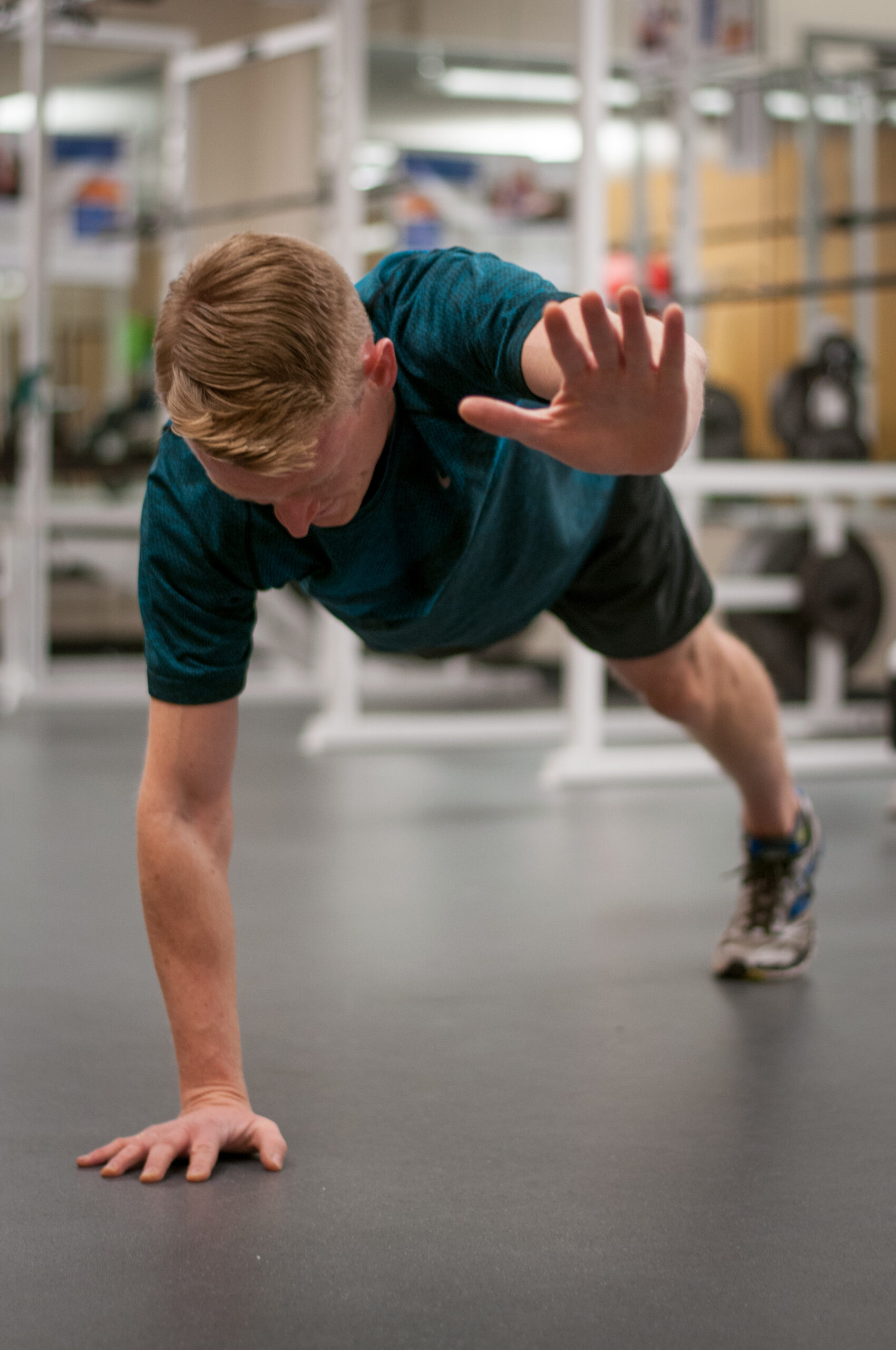
I really like exercises like the transverse rotation or T-rotation push-ups, to name a couple of examples. I think it’s key to understand your body as a whole and being able to do much of the above bracing and activation while you’re twisting is a great way to learn new patterns and create strength in some of the weakest of areas.
Posterior Support: Don’t Ignore the Back Side
Your back side matters for spinal support and fatigue resistance too. That includes spinal erectors, glutes, and the muscles that keep your hips level. I’ll mainly focus on the spinal erectors for this section.
The bird dog exercise is gold when you slow it down. Even just on the floor skydivers are a great way to get both the spinal erectors and the glutes. You really find out how tight you are or are not when doing this type of exercise. Puts things into perspective on what your body needs really quickly.
A Simple Step-by-Step Core Plan (Home or Gym) for Men
You do not need an hour of ab work to work your core, and honestly you probably don’t need an hour for every weight training session.
2-Day Core Plan (10–12 Minutes Each)
Do 3 rounds at a controlled pace, resting 30 to 60 seconds between moves, and eventually work down the rest between exercises such as 15 to 20 seconds.
- Day A: dead bug, 6 to 8 reps per side
- Day A: side plank, 20 to 40 seconds per side
- Day A: suitcase carry, 20 to 40 steps per side
- Day B: bird dog, 6 to 8 reps per side with a pause
- Day B: Pallof press, 8 to 12 reps per side (use a medium to hard resistance band)
- Day B: plank variation, 20 to 45 seconds
3-Day Core Plan (10–15 Minutes Each)
Keep it simple and rotate the focus so you recover well.
- Day 1 (anti-extension): dead bug, plank, ab wheel rollout regression
- Day 2 (anti-rotation): Pallof press, suitcase carry, side plank
- Day 3 (posterior support): bird dog, back extension variation, farmer carry
If you are newer, keep all sets submaximal.
You should finish feeling better, not folded. If this was more of a full body workout with squats or deadlifts for example, then I would tell you to just add some of these to the back end of the workout. This article is just highly focused on getting abs into focus and distinguishing between the core and what actually defines it.
FAQs
Q: What is the best core workout for men?
The best option is the one you can repeat weekly with good form. Use a mix of anti-extension (plank or dead bug), anti-rotation (Pallof press), and carries (suitcase carry) to build usable strength. Don’t forget compound exercises as a part of your overall plan!
Q: How often should men do core workouts?
Most men do well with about 2 short sessions per week, about 10 to 15 minutes. Add them after lifting or on off-days, and keep the focus on quality over fatigue. I like having clients do about 2 full body workouts with or without finishing with abs, at least 1 cardio workout and then adding 1 ab focused workout if that’s a huge goal for them.
Q: Do planks build abs?
Yes, but not in the way you think. Planks train your abs to brace hard and stay tight. However, they typically won’t give you the aesthetic appeal you’re looking for. You’re not contracting the abs and going through different movement types like flexion or extension either.
Q: Are crunches good for your core?
Crunches can help train the rectus abdominis, but they are not the full picture. Balanced core training also includes resisting rotation and side-bending for real-world stability. These were just an old staple, which is why the question is still viable today. Plus they of course have their place.
Q: What core exercises help lower back pain?
Often, dead bugs, bird dogs, side planks, and carries help because they build stability without aggressive spinal bending. If pain persists or you get nerve symptoms, get checked by a qualified pro. I also like adding other exercises like windmills to actually strengthen, reinforce and create an overall different movement capability with the twist that encompasses the exercise.
Conclusion
A strong core is not a vibe, it is a skill. It’s not a quick workout video, nor does it happen just in the kitchen like the nutritionists tell you. A strong core takes time, patience and a plan.
Keep it short, keep it consistent, and earn your progressions. Seriously.
If you want help dialing in form, building a plan around your injury history, or pairing training with nutrition and mindset support, reach out to me and I’ll help you build for the comeback. https://calendly.com/coachwilson/intro-coaching-call
No Comments