
03 Jul Strength Training For Women Over 50: A Real Guide To Building Strength, Bone Density, and a Body That Can Carry You Forward
Most women over 50 know they “should” be lifting weights. Their doctor has probably mentioned it. A friend lost a few pounds doing it. Some podcasts have made it sound life-changing. And yet… most still aren’t doing it. Or they’re doing it in a way that’s so soft, so hesitant, so disconnected from what their body actually needs that it’s barely doing anything at all.
I’ve been training women over 50 for years now. Not from a textbook. Not from a trend. From the trenches. And here’s the truth I keep running into:
The women I work with don’t need motivation. They need clarity. They need somebody to tell them straight what’s going on inside their body, what the research actually says, and what to do about it without sugarcoating it or selling them a “30-day shred.”
So that’s what this article is going to do.
If you’re a woman over 50, this isn’t a soft, fluffy “exercise is so important!” piece. This is the real conversation. The one I’d have with you in person if you sat down across from me and asked, “Where do I even start?”
Let’s get into it.
Why Strength Training Matters More Now Than Ever
Here’s something that should have been told to every woman in her 30s, but rarely was:
Starting around age 30, women begin losing muscle mass. By the time menopause hits, that loss accelerates. Starting at age 50, muscle loss speeds up, and women lose 5% to 10% of their muscle mass each decade. The drop in estrogen that comes with menopause makes these changes in body composition even worse.
That’s not a small deal. That’s your independence in twenty years. That’s whether or not you can carry your grandkids, get up off the floor, recover from a fall, walk up a flight of stairs without pain, or stay out of a nursing home longer.
I’m not trying to scare you. I’m just being honest, because most of the fitness industry isn’t.
And the bone story is even more sobering. Women can lose up to 20% of their bone mass in just the first five to seven years after menopause. One in three women over age 50 will suffer a fracture. One in three. That’s not a rare outcome. That’s the most likely outcome unless something changes.
Now here’s the good news.
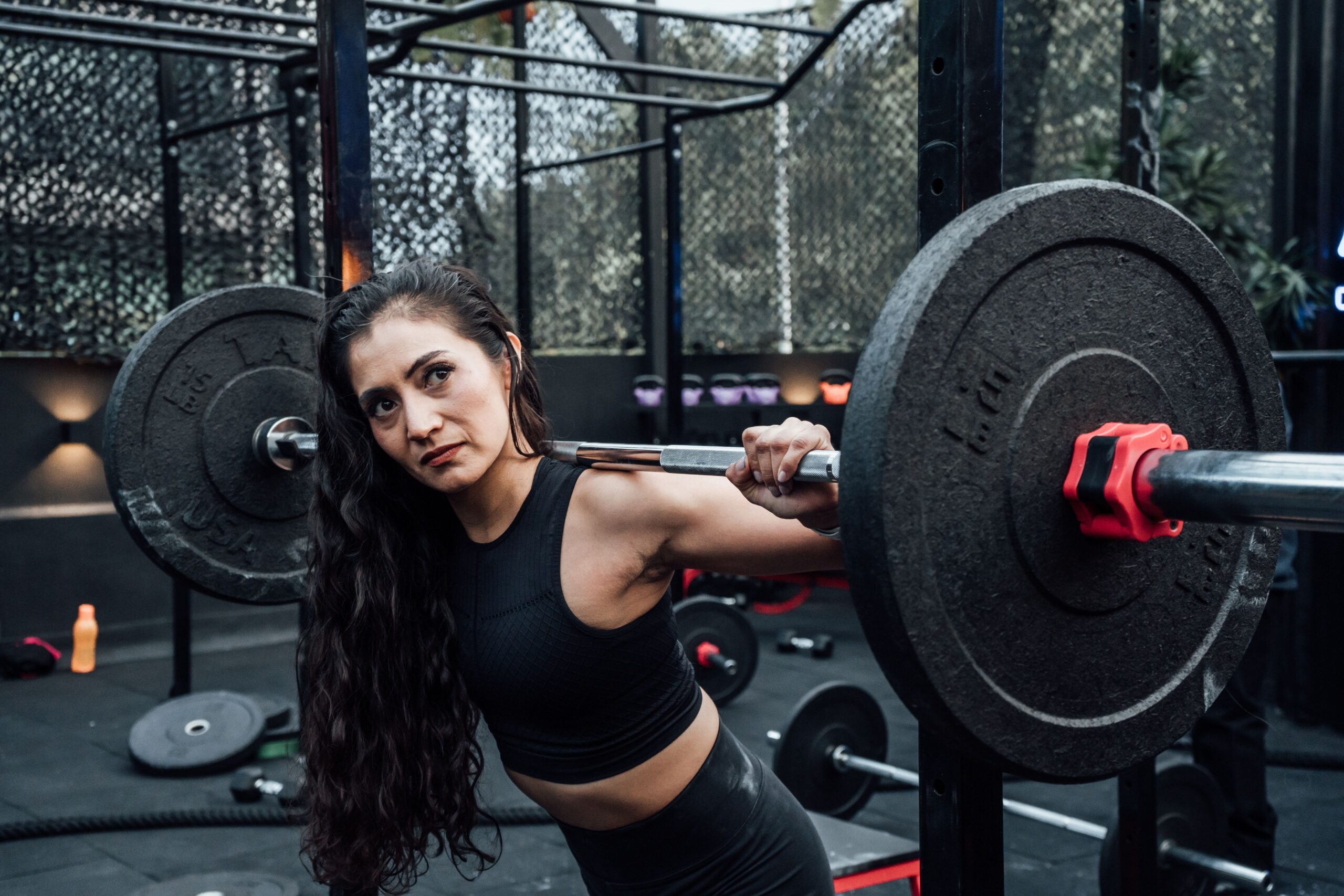
Strength training works. It’s not “one of many options.” It’s the option. The only way to slow the process and maintain, and even gain, muscle after menopause is to strength train.
That’s not opinion. That’s the consensus.
What Strength Training Actually Does for a Woman Over 50
Let’s break down what’s really happening when you lift, because most articles gloss over this and just tell you to “build muscle.” That’s not enough. You need to know why it matters, so you’ll actually keep doing it when life gets hard.
1. It Fights Sarcopenia (Muscle Loss)
Aging and hormonal changes contribute to sarcopenia, the gradual loss of muscle mass and strength. Resistance exercises counteract muscle atrophy by stimulating protein synthesis and neuromuscular adaptation, preserving functional independence.
Translation: lifting tells your body, “we still need this muscle.” Without that signal, your body has no reason to hold onto it.
2. It Rebuilds Bone Density
This is the one that actually changes the trajectory of your aging. Bones respond to stress. Lifting weights signals bones to become denser and stronger. Regular resistance training can slow bone loss and help prevent osteoporosis.
You can’t cardio your way to dense bones. You need load. You need resistance. You need to push and pull against something heavy enough to make your skeleton respond.
3. It Boosts Metabolism
Strength training enhances resting metabolic rate by increasing lean muscle mass, which burns more calories even at rest. That stubborn weight gain a lot of women blame on menopause? A lot of it is actually muscle loss in disguise. Build the muscle back, and the metabolism follows.
4. It Improves Mood, Sleep, and Mental Clarity
This one surprises people. Lifting heavy regulates your hormones in ways cardio simply can’t. It releases endorphins, dopamine, and serotonin, which help fight the irritability, fog, and low mood that often come with this stage of life.
5. It Keeps You Independent
Strong people don’t fall as easily. They don’t get hurt as often. They recover faster from surgery. They live more years where they can actually live, not just exist.
That’s the whole game.
What I Stand Against: The Lies Women Over 50 Are Still Being Told
Before we go any further, I want to clear something up, because some of these myths are still wrecking women’s progress. This is the part of the article where my opinions come out a little stronger. So bear with me.
Lie #1: “I’ll get bulky.”
No, you won’t. Building visible muscle is hard. Especially after 50. With declining hormones, building muscle is harder than at any previous point in your life. If you somehow manage to get “too muscular,” it took years of intentional effort and you’ll know how to dial it back.
Lie #2: “Light weights are safer.”
Light weights aren’t safer. They’re often pointless. If a 3-pound dumbbell never challenges your body, your body has no reason to adapt. You can absolutely start light to learn the movement, but staying light forever is one of the biggest reasons women don’t see progress.
Lie #3: “Cardio is what I really need to lose weight.”
Cardio is a piece of the picture, but if you’re losing muscle while doing endless cardio, your body composition gets worse, not better. You end up smaller and softer at the same time. Not the goal.
Lie #4: “I’m too old to start.”
Stop. An important thing we can do for our longevity is strength train. And that is true for every age, even if you start training at age 102. If a 102-year-old can benefit, you can.
How Often Should You Strength Train?
Most women I work with assume they need to lift 5-6 days a week to see results. They don’t. In fact, that’s often counterproductive.
Here’s the honest answer:
- Two to three full body sessions per week is the sweet spot for most women over 50.
- Be sure to wait 24 hours between strength training sessions to prevent injury and allow for muscle repair and recovery. Don’t do heavy strength training of the same muscle group on back-to-back days.
- More isn’t better. Better is better.
If you’re brand new to lifting, start with two days. Get good at the basics. Once you’ve built a foundation (usually four to eight weeks), add a third day. Eventually, some women add a fourth, but most don’t need to.
Remember, recovery is where adaptation happens. The workout is the stimulus. Sleep, food, and rest are where your body actually changes.
The Movements Every Woman Over 50 Should Be Doing
Here’s where most articles drop the ball. They give you 47 exercises and call it a “program.” That’s overwhelming. It’s also unnecessary.
You don’t need 47 exercises. You need to get really good at a handful of foundational movement patterns.
These are the patterns I prioritize with every female client over 50:
1. The Squat (or Squat Pattern)
This is the king. Sitting down and standing up. Going up stairs. Picking something up off the floor. The squat trains all of it.
Variations to start with:
- Chair squats (sit to a chair, stand back up)
- Goblet squats (holding a weight at your chest)
- Box squats
- Eventually, traditional barbell or dumbbell squats
2. The Hinge (Deadlift Pattern)
This is the move that protects your back, builds your glutes (which most women over 50 desperately need), and keeps your hamstrings strong. It’s also the single best move I know of for posture.
Variations:
- Hip bridges and glute bridges
- Romanian deadlifts with light dumbbells
- Kettlebell deadlifts
- Eventually, traditional deadlifts when form is solid
3. The Push (Upper Body)
Pushing strength matters every single day. Pushing yourself off the floor if you fall. Pushing a door open. Pushing a stroller, a grocery cart, a heavy box.
Variations:
- Wall push-ups
- Incline push-ups
- Dumbbell chest press
- Dumbbell shoulder press
4. The Pull (Upper Body)
This is the most neglected pattern in older women, and it’s the one that fixes posture more than any other movement. Hunched shoulders, rounded upper back, neck pain. A lot of it traces back to weak pulling muscles.
Variations:
- Resistance band rows
- Dumbbell rows (one arm at a time)
- Lat pulldowns (if you have access)
- Inverted rows with a TRX or sturdy bar
5. The Carry (Loaded Walking)
This one is underrated. Walking around holding heavy things builds core strength, grip strength, and full body resilience like nothing else. Plus it’s deeply functional. You carry groceries. You carry kids. You carry suitcases.
Try this:
- Farmer’s carries with two heavy dumbbells, walking 30-60 seconds at a time
6. Single Leg Work
I won’t go too deep here, but balance and unilateral strength matter enormously for fall prevention. Step-ups, reverse lunges, and single-leg deadlifts (when you’re ready) all matter.
That’s it. That’s your program. Master those patterns and you’ll outpace 95% of women your age.
A Sample Week of Training
Here’s a basic structure I’d give a beginner over 50:
Day 1 (Monday): Full Body Session
- Goblet Squat: 3 sets of 8-10 reps
- Dumbbell Row: 3 sets of 8-10 per side
- Glute Bridge: 3 sets of 12 reps
- Wall Push-Up or Incline Push-Up: 3 sets of 8-12 reps
- Farmer’s Carry: 3 rounds of 30 seconds
Day 2 (Wednesday): Walking, mobility, or light cross training
Day 3 (Thursday): Full Body Session
- Romanian Deadlift with light dumbbells: 3 sets of 8-10 reps
- Dumbbell Shoulder Press: 3 sets of 8 reps
- Reverse Lunge: 3 sets of 8 per leg
- Resistance Band Row: 3 sets of 12 reps
- Side Plank: 3 holds of 15-20 seconds per side
Day 4 (Saturday): Optional third lift, walk, or full rest
That’s it. Twenty to thirty minutes per session. Don’t add a bunch of fluff. Don’t overcomplicate it. Get strong on the basics first.
How Heavy Should You Lift?
This is where I lose people, but I’m going to say it anyway.
You probably need to lift heavier than you think.
Most women over 50 lift in the 5-10 pound range and stay there forever. That’s not enough resistance to drive real adaptation in muscle or bone in most cases.
A practical guideline:
- The last two reps of any set should feel hard. Not impossible. Hard.
- If you can do 12 reps without effort, the weight is too light.
- If you can’t get 6 reps with good form, the weight is too heavy.
- Aim to be in the 6-12 rep range for most of your work, with the last few reps feeling like real work.
When 8 reps become too easy, increase to 10 reps, and then progress to 12. When you’re able to do 12 reps without too much effort, it’s time to increase the weight.
This is called progressive overload. It’s not optional. It’s the entire reason you adapt.
If you’re scared of going heavier, work with someone who can teach you proper form first. That removes 90% of the risk.
Protein: The Other Half of the Equation
You can lift perfectly and still see no results if you’re underfueling. This part really matters, especially after 50.
Research shows that adults should aim to consume 1.2 to 1.6 grams of protein per kilogram of body weight, which translates to roughly 80 to 100 grams per day.
Most women over 50 I work with start somewhere around 40-60 grams a day. That’s not enough. Not even close, if you’re trying to build or maintain muscle.
Some basic protein anchors:
- Greek yogurt: 15-20g per cup
- Eggs: 6g each
- Cottage cheese: 14g per half cup
- Chicken breast: 25-30g per 4 ounces
- Protein powder: 20-25g per scoop
- Lean beef, fish, tofu: all solid choices
Spread it across the day. Don’t try to cram 100 grams into one meal. Three meals with 25-30g of protein each, plus a snack with 15-20g, gets most women where they need to be.
Form Matters More Than Weight
I know I just told you to lift heavier. Let me balance that.
If your form is sloppy, the weight doesn’t matter. You’re not getting stronger. You’re getting injured.
Movement quality is the foundation of everything I teach. Performing exercises with good form is essential. It helps prevent injuries and minimizes unnecessary stress on joints, tendons, and ligaments. Proper form also ensures that the targeted muscles are engaged correctly. Working with a personal trainer may be a good idea for beginners getting started with lifting.
If you’re brand new to lifting, or it’s been 20 years since you last touched a weight, please consider getting a few sessions with a qualified trainer to teach you the basics. It’s not a forever expense. It’s an investment in not getting hurt and in actually getting results.
I’m available too. Book an intro call and let’s see if we’re a good fit: https://calendly.com/coachwilson/intro-coaching-call
Common Concerns Women Over 50 Have (and Real Answers)
Let me address a few things I hear over and over.
“My back hurts when I deadlift.”
Probably a form issue, not a deadlift issue. Deadlifts done well are one of the safest, most beneficial moves for your back. Done sloppy, they’re a recipe for injury. Get coached on the hinge pattern before adding load.
“I have arthritis in my knees. Can I still squat?”
In most cases, yes, and you should. Strong quads and glutes actually protect arthritic joints. Just modify the depth or use box squats so you’re not going lower than is comfortable.
“I’m worried about my pelvic floor.”
Legitimate concern, especially after pregnancy or with menopause-related changes. Lifting can absolutely be safe, but it requires good breathing mechanics and core engagement. A pelvic floor PT plus a smart trainer can be a game-changing combo.
“I don’t have time.”
Two 25-minute sessions per week. That’s 50 minutes. You can do it. Most women find time once they make it a non-negotiable instead of a “when I get to it.”
“I tried before and didn’t see results.”
You probably weren’t lifting heavy enough, weren’t eating enough protein, or didn’t stick with it long enough. Real changes in muscle and bone show up over months, not weeks. There are many factors involved in maintaining good physical and mental health as you age, but one of the most important things to consider as you grow older is weight training. Strength training is one of the best types of exercises for women over 50.
The Mindset Shift That Changes Everything
I’ll be honest about something. The biggest barrier I see for women over 50 isn’t physical. It’s mental.
It’s the voice that says, “I’m too old.” “It’s too late.” “I should have started years ago.” “This isn’t really for women like me.”
That voice is wrong. Every single time.
What I tell my clients, and what I’m telling you, is this:
The next ten years are coming whether you train or not. You can either spend the next decade getting weaker, achier, and more cautious… or you can spend it getting stronger, more capable, and more confident in your body than you’ve felt in years.
That’s the real choice. Not “should I lift today or not.” It’s “what kind of woman do I want to be at 65? At 75? At 85?”
The strong version of you is built one rep at a time. One session at a time. One week at a time.
Putting It All Together
If you read nothing else from this article, read this:
- Strength train two to three times per week. Full body sessions, basic movement patterns, real resistance.
- Lift heavy enough to actually challenge your body. The last two reps should feel hard. Progress over time.
- Eat enough protein. Aim for 80-100 grams per day, spread across meals.
- Prioritize form before load. Get coached if you need to.
- Recover well. Sleep, hydration, walking, and rest days matter as much as the sessions themselves.
- Stay consistent. Consistency beats perfection every single time.
That’s it. That’s the playbook.
It’s not glamorous. It’s not trendy. It doesn’t come with a quick fix.
But it works. And it works for the long haul.
A Final Word: You’re Not Behind, You’re Right On Time
Here’s what I want you to walk away with.
You are not too late. You are not too old. You are not behind. You’re right here, right now, with the same body you’ve been carrying for decades, and that body is still incredibly capable of change.
I’ve watched 60-year-olds outlift women in their 30s. I’ve watched 70-year-olds drop their canes after a year of consistent strength work. I’ve watched women rediscover parts of themselves they thought were gone for good.
It happens because they showed up. They picked up the weight. They trusted the process. They listened to their body, but they didn’t let fear be the loudest voice in the room.
That can be you too.
If you’re ready to start and you want help making sure you’re doing it right, let’s talk. Book an intro call here: https://calendly.com/coachwilson/intro-coaching-call
Or shoot me an email: coachwilson10459@gmail.com
You’ve got more strength in you than you realize. Let’s go find it.
Train with Jeff.
No Comments