
09 Jul Best Bodyweight Exercises to Build Muscle (No Gym Required)
You have been here before. No gains. Wondering what to do. More protein? More volume? You want to get stronger. You have the motivation, at least right now. More importantly, you wonder that without equipment, without a rack full of weights, a quiet voice in the back of your head keeps asking: is this even going to work? Are bodyweight exercises enough to actually build muscle, or am I just going through the motions?
That doubt is not laziness. It is the result of an industry that has spent decades telling you that real training requires a membership, a machine, or a monthly supplement subscription. The fitness world has a financial interest in making you believe your body is not enough on its own.
It is lying to you.
Your body is one of the most effective training tools ever created. Used correctly and progressed with the right plan, bodyweight training can build real, lasting muscle, sharpen how you move, and give you a foundation that holds up no matter where life takes you. And the research backs that up completely.
I have been coaching for 15 years. I have watched people transform their bodies with nothing but floor space, a pull-up bar, and a commitment to showing up. I have also watched people with expensive gym memberships spin their wheels for years because they had no real plan.
The difference was never the equipment. It was always the approach.
This article gives you that approach. The best bodyweight exercises to build muscle, the science behind why they work, how to keep progressing when things get easy, and what to do when you feel stuck. Let us get into it.
Can Bodyweight Training Actually Build Muscle?
Yes. And you do not have to take my word for it.
Research published in the journal Physiology and Behavior found that, as a form of resistance training, body-weight exercise helps build muscle “independent of an external load.” When researchers looked at the effects of 10 weeks of body-weight exercises on various physical fitness parameters, they found improvements in seven out of nine parameters measured. The biggest gains were in aerobic capacity, with a 33% improvement. Muscle endurance in the core increased by 11%, while lower-body power posted a 6% gain. Even flexibility improved after the training.
A recent 8-week study compared two groups of beginners, one using only bodyweight exercises and the other using free weights. The results showed that both groups gained the same amount of muscle.
Same muscle. No weights required.
Bodyweight routines, if progressively structured, can strengthen nearly every major muscle group. Optimizing form and movement mechanics plays a key role in maximizing results.
The phrase “progressively structured” is the key. That is where most bodyweight programs fail. They hand you a list of exercises without teaching you how to make them harder over time. You do the same push-ups for three months, wonder why nothing is changing, and conclude that bodyweight training does not work.
It does work. But only if you have a plan. Here is yours.
The One Principle That Separates Results from Spinning Your Wheels
Before we get to the exercises, you need to understand progressive overload. Without it, you are just moving your body around. With it, you are building something real.
Progressive overload is the gradual increase of stress placed on your body during training. Your muscles adapt to the demands you place on them, so to continue getting stronger, you must consistently challenge them in new ways.
The concept was first documented by Thomas Delorme in the 1940s while rehabilitating injured soldiers. He discovered that gradually increasing resistance produced far better results than fixed-intensity exercise. Today, progressive overload is the foundation of every effective strength program, whether you use barbells, machines, or your own bodyweight.
With weights, progression is simple: add plates. With bodyweight training, you have more creative options, and most of them are more interesting.
You can pause at the hardest part of the movement, eliminating the stretch reflex and forcing your muscles to generate force from a dead stop. You can add reps, add sets, slow your tempo, reduce rest time, or advance to a harder variation of the same movement.
The best evidence we have shows that anywhere from 6 to 20 reps stimulates a similar amount of muscle growth. The key is keeping your reps within a range that creates a meaningful challenge. If reps drift too low or fly too high, muscle growth slows.
For most exercises below, aim for 3 to 5 sets of 8 to 15 reps, at a difficulty level where the last two reps of every set are genuinely hard. That is where the growth happens.
Your Three-Step Roadmap to Building Muscle with Bodyweight Training
Before the exercise list, here is the simple framework I use with every client who trains without a gym. Three steps. That is all this takes.
Step 1: Learn to move well. Before you chase reps or intensity, make sure your form is clean. Sloppy movement builds sloppy muscle and sets you up for injury. Every exercise below includes form cues for exactly this reason.
Step 2: Master the basics and build your base. Push-ups, pull-ups, squats, lunges. These are not beginner exercises. They are the foundation of everything else. Own them before advancing.
Step 3: Progress deliberately and track everything. Add a rep. Slow your tempo. Advance to a harder variation. Write it down. Progress that is not tracked is progress that disappears.
That is the whole system. Now here are the exercises that make it work.
The Best Bodyweight Exercises to Build Muscle, By Category
I teach a well-rounded approach that combines push, pull, and lower body work alongside core stability. That balance is not optional. It is what separates a body that looks good from a body that actually performs and lasts.
PUSH: Upper Body Pressing Strength
Push-Ups
Push-ups are the foundation of upper-body bodyweight training and one of the most underrated exercises in existence. Done right, they build the chest, shoulders, triceps, and core simultaneously.
Push-ups engage multiple upper-body muscles simultaneously, making them one of the most efficient strength builders. They develop chest, shoulder, triceps, and core stability while improving functional pushing power for daily activities. Muscles worked include the pectoralis major, triceps brachii, anterior deltoids, and core stabilizers. If you squeeze your butt and abs during the exercise, then you add a few more! Makes it harder too. Remember that moving forward, especially with body-weight exercises.
How to do them: Place your hands slightly wider than shoulder-width apart, body in a straight line from head to heels. Lower your chest toward the floor with control, keeping your elbows at roughly a 45-degree angle from your torso. Press back up to full extension.
How to progress: Start with knee push-ups if needed, or maybe elevated onto a bench, a table or a countertop. Move to standard push-ups, then close grip, T-rotation push-ups, decline push-ups, then spiderman (look that one up!), and for fun maybe later add on clap push-ups to get some explosive power in there. When standard push-ups feel easy, slow your lowering phase to three full seconds before pressing back up. That single change will humble most people.
*Remember, tempo adds so much to any exercise. It’s easy to get stuck on sets and reps, but tempo and even isometric pauses are great for both gains and just simply adding variation to your routine.
Dips
Dips are often called the bodyweight squat for the upper body due to their effectiveness in building muscle and emphasizing large muscle groups. I actually have no idea if that comparison is true, but I’m going with it.
You will feel the most tension in your chest, triceps, and shoulders. Because such a large number of muscles are recruited to perform a dip, this promotes muscle growth, as compound movements trigger the body’s natural release of more testosterone and growth hormone.
How to do them: Using a sturdy chair, parallel bars, or dip station, place your hands at your sides, arms straight, and lower your body by bending your elbows to about 90 degrees. Keep your chest lifted and avoid flaring your elbows out; keep them close to your torso for better joint safety. Press back up to the starting position.
How to progress: Begin with chair dips using your feet on the floor for assistance. Gradually walk your feet further away to increase the load. When you can do 3 sets of 15 clean reps, advance to full parallel bar dips. After that, if you want to go a little against the grain of this article sometime down the line, then add a weight belt and progress from there.
Pike Push-Ups
Disclaimer: This is for highly experienced people.
If you want to build shoulder mass without a barbell, this is your movement.
Pike push-ups are the entry point: get into a downward dog and press your head toward the floor between your hands, then drive back up.
How to progress: Work on the above for a long time before trying this. In most cases. Your background matters a lot here too.
PULL: Upper Body Pulling Strength
Pull-Ups and Chin-Ups
These are non-negotiable. If you want a strong, muscular back and arms without a gym, pull-ups and chin-ups are the most direct path available. They are also the exercise most people skip because they require a bar and, initially, more effort to get right.
That effort is worth it. Every single time.
Pull-ups with palms facing away emphasize the lats and upper back. Chin-ups with palms facing toward you increase biceps involvement while still hammering the back.
A resistance band is a great tool to help build strength for proper pull-ups. Once you feel confident doing assisted pull-ups and can support most of your own weight, start doing negative pull-ups: jump and hold yourself above the bar, then slowly lower yourself under control to the starting position. This is a great way to build enough strength to eventually get your first unassisted pull-up.
How to progress: Assisted pull-ups with a band, then inverted rows using a barbell or something like it (which yes, that might require a gym or some form of equipment, but that’s no different than using a bench or counter top for incline push-ups. Then negative pull-ups, then full pull-ups with increasing reps, then weighted pull-ups using a backpack.
Inverted Rows
Not everyone has a pull-up bar yet, and not everyone can do one yet. Inverted rows solve both problems.
Set a sturdy table at hip height, lie underneath it, grip the edge with both hands, and row your chest up to the surface. The more horizontal your body, the harder it gets.
Muscles worked: upper back, rear deltoids, biceps, and core. This is one of the most overlooked exercises in bodyweight training, and one of the most effective for building the pulling strength that eventually earns you your first pull-up.
LOWER BODY: Leg and Glute Development
Bodyweight Squats and Bulgarian Split Squats
The squat is a pillar of human movement. Squats build your lower body like few other exercises and are great for athletic performance across a wide range of sports. They can even prevent or reverse age-related muscle loss in older adults as part of a well-rounded strength routine.
Standard bodyweight squats are a starting point for beginners and a useful warm-up for advanced athletes. But if you want to build serious leg muscle without weights, you need to advance to unilateral work.
The Bulgarian split squat is arguably the single most effective unilateral leg builder available. It sucks honestly, but it’s worth it. You place one foot on a bench, couch, or chair behind you and squat down with the front leg. Split squats require a mix of balance, strength, and mobility, and they can function as both a primary quadriceps builder and a glute builder depending on your body position.
How to progress: Bodyweight squat, then Bulgarian split squat, then pistol squat, then jump squats for power development. You may want to use some assistance on the single leg ones. Get creative there and don’t use too much assistance!
Reverse Lunges
Lunges improve lower-body strength, stability, and unilateral balance, helping correct muscle imbalances between legs. Muscles worked include the glutes, hamstrings, quadriceps, and calves. This could also be a part of above progressions for the squat, technically speaking.
Reverse lunges are often easier on the knees than forward lunges and allow for better control, making them an excellent starting point for building single-leg strength.
How to do them: Stand tall, step one foot back, and lower until both knees reach roughly 90 degrees. Drive through your front heel to return to standing. Alternate legs. Going 90 degrees isn’t written in blood, but it’s a good mark to aim at.
How to progress: Stationary reverse lunges, then walking lunges, then lateral lunges to target the inner thighs and add hip mobility work.
Glute Bridges and Single-Leg Variations
Bodyweight leg training can become very quad-dominant. Squats, lunges, and step-ups are valuable, but without direct glute and hamstring work, you will build imbalanced strength. Bridges fix that.
The glute bridge isolates and strengthens the glutes, improving hip stability and lower-back health. Lie flat with knees bent and feet flat on the floor. Lift your hips until your shoulders, hips, and knees form a straight line. Lower slowly without letting your hips touch the ground. Squeeze your glutes at the top and avoid arching your lower back.
How to progress: Two-leg bridges, then single-leg bridges, then single-leg hip thrusts with your upper back on an elevated surface for a greater range of motion and more glute activation. Then do some single leg ones, with your heel up on the grounded foot. Adds some calf variance and a little more need for stability during the single leg bridge or hip thrust.
CORE: Stability and Anti-Rotation Strength
Plank Variations
A true plank is an active isometric hold that builds deep core stability, trains your body to resist spinal flexion under load, and lays the groundwork for every compound movement you do. It is not a rest exercise. Not even close.
How to do them: Forearms on the floor, body in a straight line from head to heels, glutes squeezed, belly button drawn in. Hold without sagging at the hips or piking at the waist.
How to progress: Standard plank, then RKC plank where you squeeze every muscle as hard as possible, then plank with alternating arm or leg lifts, then side plank, then side plank with hip dips.
Dead Bug
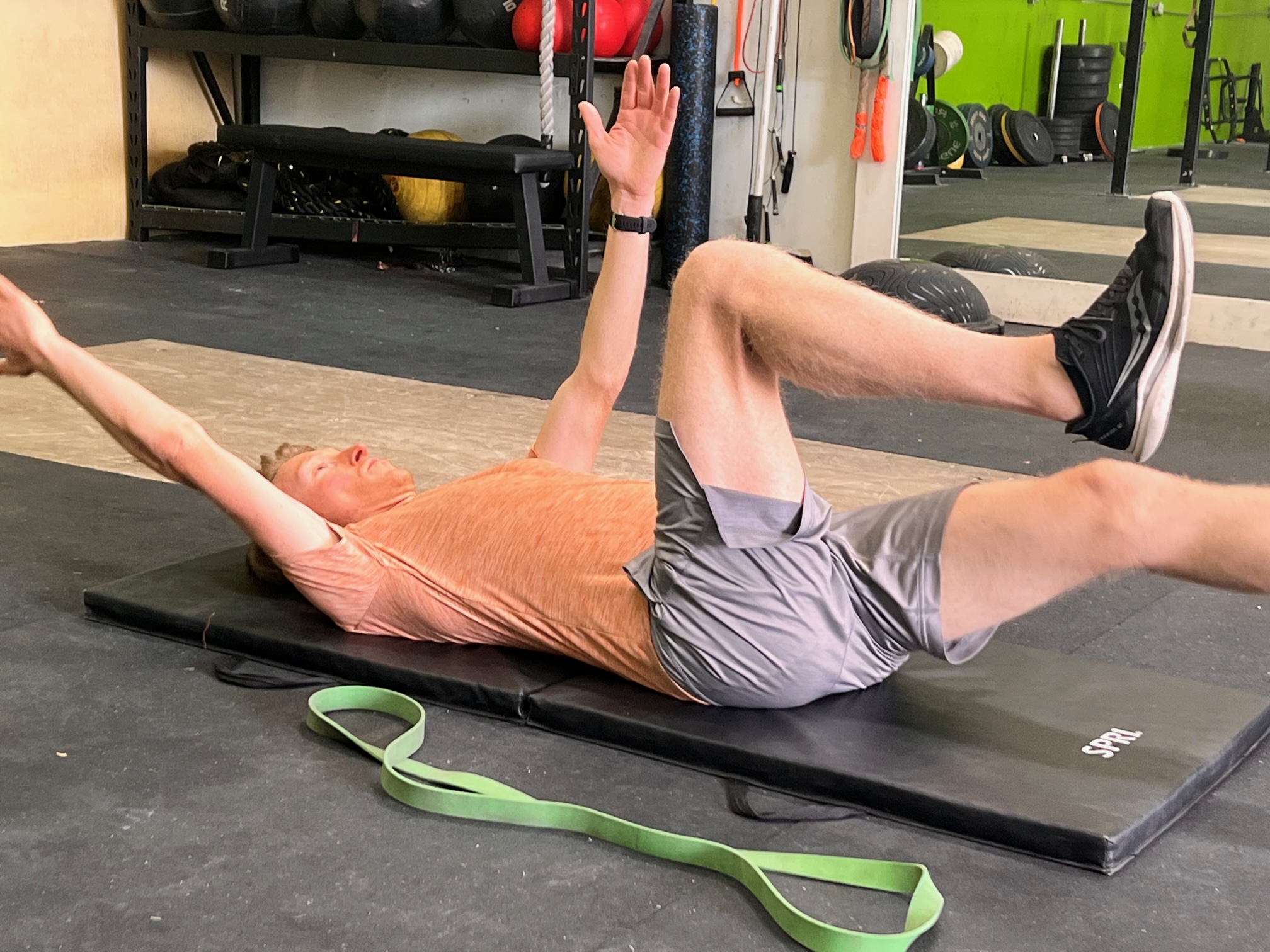
This is one of the best exercises for training core stability in a way that directly translates to everything else you do. It teaches your spine to stay neutral while your limbs move independently, which is exactly what happens during every other exercise on this list.
How to do them: Lie on your back with arms pointing toward the ceiling and knees bent at 90 degrees in the air. Slowly lower your right arm overhead and your left leg toward the floor simultaneously, keeping your lower back pressed into the ground throughout. Return and alternate sides. Move slowly. Breathe.
Progression: Personally I like adding a little mini band/ankle band to the soles/tops of the feet to make this movement extra difficult.
Mountain Climbers
Mountain climbers get your heart rate up while improving your overall body strength. Start in a high plank position with your hands shoulder-width apart, resting on the balls of your feet. Drive one knee toward your chest, then switch in a controlled running motion. Keep your hips level and your core engaged throughout.
Mountain climbers are a dual-purpose tool: they build core endurance and elevate your heart rate, making them an ideal finisher at the end of any bodyweight session.
Progressions: I really like getting creative on these and trying different speeds, pauses and criss crossing the knees moving forward, and/or adding a leg lift in between some of the original movement pattern. Point is to change things up after you’ve mastered the original movement, whilst somehow having fun!
How to Put It All Together: Your Sample Bodyweight Muscle-Building Routine
Here is a three-day-per-week structure built on the three-step roadmap above. It hits every major muscle group, allows for adequate recovery, and applies progressive overload principles from day one.
Day A: Push and Core
- Pike push-ups (if ready or just take this out for now): 3 sets of 8 to 12 reps
- Push-ups with 3-second lowering phase: 3 sets of 10 to 15 reps
- Dips: 3 sets of 8 to 12 reps
- Plank: 3 holds of 30 to 60 seconds
- Dead bug: 3 sets of 8 reps per side
Day B: Pull and Core
- Pull-ups or negative pull-ups: 3 sets of 5 to 10 reps
- Chin-ups: 3 sets of 5 to 10 reps
- Inverted rows: 3 sets of 10 to 15 reps
- Side plank: 3 holds per side of 30 to 45 seconds
- Mountain climbers: 3 sets of 20 seconds
Day C: Lower Body and Core
- Bulgarian split squats: 3 sets of 8 to 12 reps per leg
- Reverse lunges: 3 sets of 10 reps per leg
- Single-leg glute bridge: 3 sets of 12 reps per leg
- Jump squats: 3 sets of 8 reps, if your joints are healthy
- Dead bug: 3 sets of 8 reps per side
- Plank variations: get creative with sets and reps and variations.
Rest at least one day between sessions. Every one to two weeks, add a rep, slow your tempo, or advance to a harder variation. Track your sessions so you always know whether you improved. What does not get tracked does not get better. Eventually get to 4 sessions, especially if you’re bent on sticking with body-weight.
What Your Life Looks Like on the Other Side of This
Picture this.
You can do ten clean pull-ups anywhere in the world: in a hotel room doorframe, a park, a playground. No membership required. You are moving through your days with a body that feels capable and strong. You are not dreading workouts because you do not have time to get to a gym. Your training fits your life instead of fighting it.
Your lower back does not ache after a long day of sitting. Your posture is better because your core is actually working the way it is supposed to. You are sleeping better because your body is being used the way it was designed to be used.
That is not a fantasy. That is what happens when people follow a well-built bodyweight program with consistency and patience. I have watched it happen dozens of times. It can happen for you too, but only if you actually start, stay consistent, and progress with intention.
The Biggest Mistakes That Keep People Stuck
Most people who fail at bodyweight training, or any type of training for that matter, do not fail because the method does not work. They fail because of one of these avoidable patterns.
They stop progressing. Once push-ups feel easy, most people just do more push-ups. That is maintenance, not growth. You need to make the movement harder, not just longer.
They skip pulling movements. Push-ups, dips, and squats feel intuitive. Pull-ups and rows require more setup. So people skip them and end up with shoulder imbalances and postural problems that compound over time. Do not skip pulls.
They treat bodyweight training as a beginner’s program. With the right techniques, you can continue to build muscle and strength with bodyweight exercises for years. Effective calisthenics can challenge even the most advanced athletes. Unless you can do 20 or more reps of handstand push-ups, one-arm chin-ups, and planche push-ups, there is plenty of room to grow.
They underestimate nutrition. No training program works without adequate fuel. You need enough protein to repair and build muscle tissue, and enough total calories to support the work. Bodyweight training is not a free pass to undereat.
They quit at three months. Three months is when visible changes usually start appearing. It is also, unfortunately, when many people quit. This mark separates those who build lasting fitness from those who cycle through programs. The people who stay past the three-month mark are the ones who get the results they were after when they started.
Information alone does not fix any of these patterns. Accountability does. A clear plan, someone in your corner, and consistent check-ins change the math entirely. That is what coaching is for, and that is what I do.
Common Mistakes That Kill Your Progress
Holding your breath. Breath and movement are a team. Holding your breath spikes abdominal pressure and reduces stability. Breathe out on the effort, breathe in on the return.
Rushing the reps. Speed is the enemy of muscle growth in most cases. Slow, controlled reps create more time under tension, which is one of the primary drivers of hypertrophy. If your reps look like flailing, they are probably not doing much.
Skipping rest days. Your body does not grow during the workout. It grows during recovery. Training every day without a structured rest plan is one of the fastest routes to burnout, stalled progress, and injury. Rest is part of the program, not a deviation from it.
Squeezing the wrong muscles. This is especially common with core work. During planks, dead bugs, and mountain climbers, many people compensate with their hip flexors or lower back instead of their deep core. Slow down, feel the right muscles working, and do fewer reps with better activation if needed. This takes a lot of practice but even if you’re a beginner, I want you to at least hear that this is something to focus on at some point. Probably not right away, unless you just don’t feel right.
Frequently Asked Questions About Bodyweight Training for Muscle
Can bodyweight exercises build as much muscle as lifting weights?
For beginners and intermediate athletes, research says yes. An 8-week study comparing beginners doing only bodyweight exercises versus free weights found that both groups gained the same amount of muscle. At more advanced levels, progressing to difficult single-limb movements or adding load through a weighted vest becomes necessary to keep driving gains.
Eventually the well runs dry though if you’re doing this for years. Not because there aren’t enough variations or reps that can be done, but because you’re human and I think weights are more important in the long run than trying to prove that you don’t need a gym.
How many days a week should I train for muscle growth?
Three to four days per week is the sweet spot for most people. This gives each muscle group enough stimulus to grow and enough rest to recover properly. Training every day without a structured plan is one of the fastest routes to stalled progress.
Do I need any equipment at all?
A pull-up bar makes a significant difference. It opens up the entire pulling category of movements and dramatically improves the balance of your program. Resistance bands are also a worthwhile addition, especially for assisted pull-up progressions. Beyond that, a floor and your body are genuinely enough to get started.
How long does it take to see results from bodyweight training?
With consistency, visible results can appear within four to eight weeks. Strength gains often come before visible size changes. You will likely feel stronger and move better before you notice significant changes in the mirror. Trust the process through those early weeks. They are building the foundation everything else sits on.
In most areas of physiology, just a few weeks can start to show changes. Even as low as 3 or 4 can start to see benefits, but let’s aim at 8-12 to really start seeing some results and getting excited about the work you’re putting in.
What is the hardest bodyweight exercise to build muscle?
The pistol squat, one-arm push-up, and pull-up with added weight are among the most challenging. The pistol squat works all the major muscle groups of the legs with significant tension, as all of your bodyweight is on one leg and you must control your balance and stability simultaneously. Most people spend months building toward it. That is the point. This is always going to be a debate. Bulgarians I think are the hardest exercise almost ever, but that is coming from using weights for that one too. Pull-ups are always going to be close to, if not the hardest for most people. It’s just hard. It’s like running.
How do I keep progressing when exercises start to feel easy?
Progressive overload is not optional; it is the foundation of strength development. The beautiful thing about bodyweight training is that you have countless ways to progressively challenge yourself, from adding reps to mastering advanced skills. The key is consistency and patience. Small improvements, applied week after week, lead to extraordinary results over time.
The Bottom Line
You do not need a gym. You need a plan, a commitment to progressively overloading your movements, and the consistency to keep showing up even when it is inconvenient.
The exercises in this article give you a complete, evidence-based system for building a strong, capable body with nothing but your own body weight and the willingness to work. Push, pull, squat, hinge, brace. Progress. Repeat.
The fitness industry will keep selling you complexity. I am selling you the opposite: clarity, consistency, and a method that works because it is built on how your body actually adapts, not on trends or hacks.
Your body is enough. The question is whether you are ready to use it.
Show up. That is where the real change happens.
Jeff Wilson is a personal trainer with 15 years of experience helping people rebuild strength, resilience, and confidence through movement. He takes a holistic approach to fitness that addresses the whole person, not just the muscles you can see.
No Comments