
For some reason, we’ve created these numbers, ages, and times of life where we are supposed to have certain things done or be a certain way, etc. Overall, it’s pretty fascinating. Ironically I was coming home from Denver the other day from a Detroit Red Wings and Colorado Avalanche hockey game (I am a Wings fan btw!) and I was trying to figure out what to listen to. For some reason I wasn’t feeling very good about my life. I am 39 and in the last couple of years I’ve had a lot of issues mentally with where I’m supposed to be. Last year was just simply a tough year for me, for many reasons.
That night, I decided to listen to a Mel Robbins podcast on feeling behind. Liked it. The point of me bringing this up is that in the podcast she gives all of these stats about ages and things we’ve established as societal norms which have ultimately brought so much stress to so many people, but we live in such a different time.
The bridge I’m making here is that plenty of people hit 40 and decide their best days of training are behind them. Joints feel tighter, recovery takes longer, and a busy job and family leave little time for the gym. It's easy to accept a slow slide as just part of getting older.
However, I think that’s horseshit. One of the things I want to do with my life and career is help people believe they can have a great life, later in life. Not just a slow decline. We should basically only decline after a huge late stage diagnosis of some sort, where it’s an inevitable decline. I know there’s going to be subjective opinions about that, but to each their own. I just want to help more people believe they can fight through the normal times in life and not think they’re old when they’re 36 or even 51. It’s just not old, but we’ve constructed an environment where we just believe that, regardless of our individuality. Like it’s a given.
That slide I mentioned earlier isn't a given. Strength training over 40 looks a little different from training at 25: more attention to recovery, smarter loading, and a plan that works with the body's changes rather than against them. The payoff doesn't require living in the gym, though.
This guide covers what changes after 40, how to start or restart, how heavy to lift, how often to train and recover, what women and men each need to know, the "bulky" question, training around achy joints, and how training shifts through the 50s, 60s, and beyond.
1. Strength training matters more after 40, not less: muscle, bone, joints, and hormones all respond to it, and more of us sit at desks all day.
2. Start lighter than you think, then lift with 2 or 3 good reps left in the tank and add weight slowly.
3. Two or three sessions a week, with real recovery, works for most people over 40.
4. For women, I think lifting matters more than cardio at this stage, and getting bulky by accident is almost impossible.
5. It's not too late. Within a couple of years, you can be a completely different person.
Muscle and strength tend to decline with age when nothing is done about them, and MedlinePlus notes that muscle changes often begin in the 40s in women.
Time is on your side, too. Someone who's 42 could live into their 90s, which means more than half of adult life may still be ahead. That's a long time to be either stronger or weaker. Even if you're 82 and don't feel like you have more than a couple of years left, don't you want to make them as enjoyable as possible? People ask me if they're too old all the time. My answer: within a couple of years, you can be a completely different person.
Lifestyle plays a big part. Far more of us work at desks now, with less physical work built into the day, which makes deliberate strength training more important. Questions about hormone levels or treatment belong with a doctor; my job is the training.
There are two kinds of people starting at 40 and beyond: true beginners, and people who lifted in their 20s or 30s and are coming back. Both do best starting lighter than they think. Returning lifters remember what they used to lift, and their joints and tendons may not have caught up with that memory.
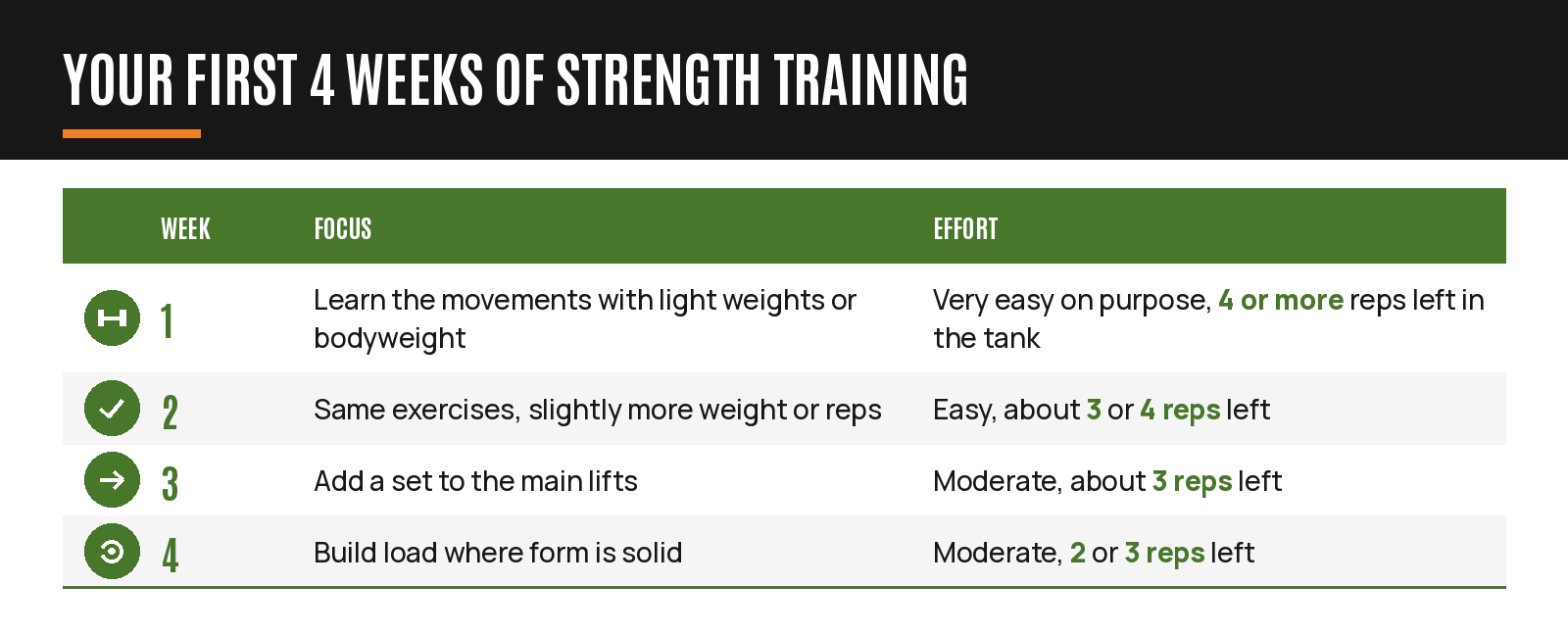
Sessions cover the main movements: a squat, a hinge, a push, a pull, a single-leg exercise, and a carry. Goblet squats, kettlebell deadlifts, push-ups, rows, step-ups, and farmer's carries are a common starting set. I do some type of carry in almost every workout. Two sessions a week is enough to start, and it looks the same for women and men at this stage.
The most practical guide is effort, measured as reps in reserve: how many more good reps you could do at the end of a set. Researchers have found that a scale based on reps in reserve is a practical way to adjust training load from day to day.
The American Heart Association notes that one set of 8 to 12 reps, worked to fatigue, is usually enough for each muscle group, and more sets may lead to slightly greater gains. Two or three sets is a solid middle ground. There's no set weight a woman over 40 should lift, but pink 2-pound dumbbells rarely get anyone there. Most of my clients can lift more than they expect once they learn the movement.
The AHA recommends working each muscle group at least twice a week, with "a minimum of two days of rest between workouts" for that muscle group. Full-body sessions on Monday and Thursday fit that easily. My general recommendation is two days of lifting and two days of cardio, with 30 to 45-minute sessions.
Recovery is where training after 40 changes most:

Several of these together for a week or two is a sign to take a lighter week.
If you'd like help finding the right starting weights for your body, you can book a consultation with me in Colorado Springs.
Strength training for women over 40 matters for bone density, joint health, and just feeling more vibrant. The International Menopause Society recommends at least 150 minutes of moderate aerobic activity plus two or more days of strength training a week, and says exercise "is one of the most powerful tools to counteract the effects of estrogen loss during menopause."
I'll be upfront: I'm not an expert on what happens hormonally when menopause hits, and it's something I want to study more. What I can tell you from coaching is that lifting matters more than cardio for most women at this stage. Cardio is still important, but it doesn't build and keep muscle. I've seen a lot of older women who mostly run get smaller and smaller. I once watched a barre class of women in their 50s and 60s, and many of them looked very thin, without much muscle tone. Classes are fine, but see best workout for women over 40 for how they compare with lifting.
Menopause strength training rarely needs a special program, just a few adjustments:
Symptoms, hormone therapy, and anything unusual are questions for a doctor or menopause specialist.
Testosterone lowers quite a bit for men as they age, and average male testosterone levels appear to be lower than in past generations, even though we have more information and supplements than ever. Whether lifting changes your hormone levels is a question for your doctor, but lifting does give you a little boost, and the case for keeping muscle doesn't depend on it. Add more time sitting at a desk, and men over 40 need deliberate strength work.
Common traps I see:
Workouts for men over 40 don't need to be long. See strength training for men.
If you take one thing from this article, take this: it's almost impossible for women to get bulky by accident. Building big, bulky muscle takes heavy, dense workouts three to five times a week, steady progression for months or years, and a lot of protein. Even then, most women find it very hard.
What usually changes instead is how your body looks and feels. Muscle tone shows up, clothes fit differently, and everyday tasks get easier. Muscle is also like padding around your bones, which matters more every year. Being thin is fine, but a decent amount of muscle is a big part of looking and feeling good at 40 or 70.
Some stiffness is normal after 40, and lifting often helps more than resting:
Bone health matters too, especially for women after menopause.
The American Heart Association says adults with cardiovascular disease, chronic conditions, or pregnancy should check with a professional before becoming more active, and advises breathing regularly, because "holding your breath can raise blood pressure and cause muscle cramping". Anyone with high blood pressure, a recent surgery or joint replacement, or new chest pain or dizziness should get a clinician's input first. Sharp pain is a reason to stop. I coach movement and strength; diagnosing and treating pain is a job for a medical professional.
Power training, standing up from a chair a little faster or stepping up with a quick drive, has a place too, always with something sturdy nearby.
Strength training over 40 isn't about recapturing 25. It's about building a body that stays capable for the next 40 years or more. Start lighter than seems necessary, lift with a couple of reps in reserve, recover on purpose, and show up two or three times a week, for years rather than weeks. The earlier you start, the more time you have to benefit, and starting later still leaves time to gain.
Here's a comment from one of my clients. She started working with me when she was 45.
"I was afraid that after 40 my body was going downhill. I had chronic low back pain and I just didn't feel strong. I started working with Jeff, and I was blown away by how quickly I saw improvements. I had tried a lot of cardio classes and just wound up feeling depleted. But he encouraged me to lift heavy weights (which was weird at first) and I was amazed at how well it worked. My back pain was gone. And I had so much more energy. Highly recommend Coach Jeff. He really knows how to help." - Tiffany, Colorado Springs
If you're in the Colorado Springs area and want help starting or restarting strength training after 40, book an in-person consultation. I'll look at how you move, find the right starting weights, and build a plan around your recovery, your joints, and your goals.