
Most people obsess over the workout. Exact reps, rest, what pre-workout to take, how it looks, etc. All good things…well except pre-workout of course! However, in most cases you’d be better off obsessing over the recovery aspect of your training than the workout.
Very few pay attention to post workout recovery. Again, not the exact protein to drink or all the “typicals” that people have been obsessing over the last couple of decades, but the actual full scale recovery period, post workout. But here’s the truth. You don’t get stronger during training. You get stronger during the recovery process.
Every tough workout, whether it’s resistance exercise, endurance work, or an intense workout in the gym, creates stress. Adaptation happens only if you recover well enough to support muscle repair, restore energy, and prepare for the next workout.If your recovery is sloppy, your progress will be too. If your recovery is overlooked, so will your gains. Let’s talk about what to look for and how to do it right.
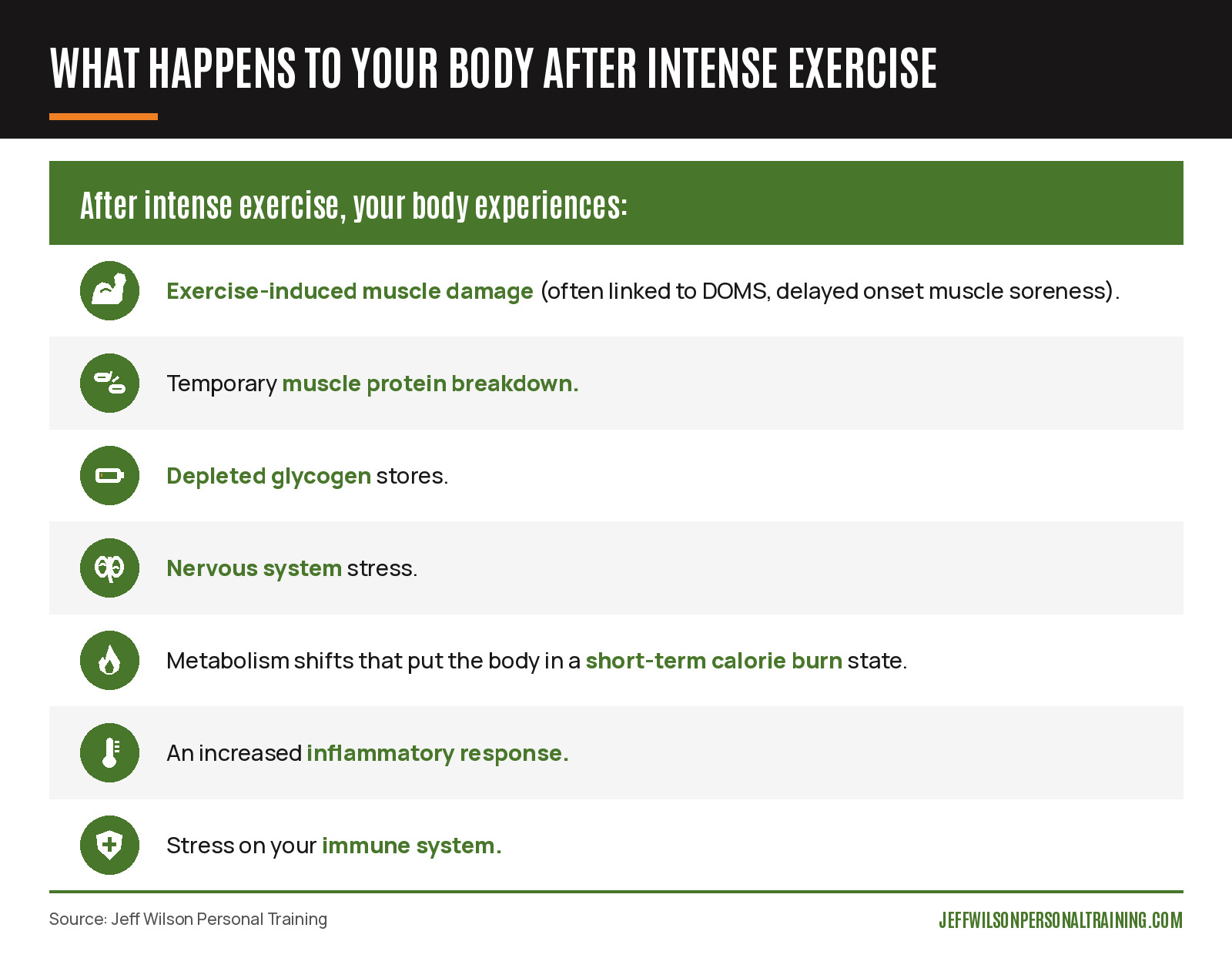
This isn’t bad, since it’s part of the adaptation process. Tiny disruptions in muscle fibers signal your body to rebuild stronger. Through muscle protein synthesis, your body uses amino acids as building blocks to repair muscle tissue, improve muscle function, and support muscle growth. But that only happens with adequate recovery. There’s always more science to talk about, but there’s not enough application so let’s get back to the needed points here.
We’ve all felt delayed onset muscle soreness (DOMS). That deep muscle soreness that shows up 24-48 hours after a tough workout.A little soreness is normal. But constantly being crippled with sore muscles is not a badge of honor. It’s often a sign you’re not managing training load or recovery well. Don’t aim for soreness and don’t aim for being tired all the time. When your ego gets too involved, so does your loss of gains. If you want to reduce muscle soreness, enhance recovery, lower your risk of injury, and improve on your goals long-term, you need a smarter recovery strategy.
Your post workout meal matters more than most people think. After training, your body is primed to replenish glycogen stores, begin tissue repair, and kickstart protein synthesis. What you eat in that window gives it the raw materials to do all three.
High quality protein is essential. Protein helps repair damaged muscle and supports muscle protein synthesis, so it should be the anchor of any post workout meal.
Whey protein is definitely a solid option. I used one from Standard Process. Lean meats are another strong choice, including odd ones like liver. And eggs? Who doesn't like eggs? Easy win here.
Plant based proteins are always a hot topic. The best approach is simple: pick something that works and stick to it. Greek yogurt and nuts are another easy win. It doesn't have to be that exact combo, but it's quick and hard to mess up.
Whatever you choose, aim for protein that contains essential amino acids, which directly support muscle repair and growth.
Carbs refill energy stores. Think basic options here. Whole grains, fruit, potatoes, and rice all do the job without overcomplicating things.
Post workout nutrition isn't about perfection. It's about giving your body proper nutrients so muscles recover faster. Also, make sure you eat your veggies. The mineral content is off the charts, especially when you're consistent.
After intense resistance exercise or endurance exercise, complete stillness isn't always ideal. Don't fall into nothingness after every workout just to recover. Just because you're tired doesn't mean sitting and doing nothing is the answer.
Active recovery can do wonders for the body, especially long-term. Light physical activity like walking, cycling, or mobility work can improve blood flow and help clear metabolic byproducts. Better circulation means improved nutrient delivery and faster recovery. It also reduces muscle stiffness and improves range of motion. On top of that, you'll usually notice better overall energy.
You don't need another intense workout. You need intentional movement. Sometimes yoga, or even a really light workout at about 30 to 40% of your usual intensity and volume, is enough to get things flowing.
There's a time and place for both dynamic stretches and static stretches. Keep it simple, but don't overlook it.
Dynamic stretches work well immediately post exercise to keep the body moving. Static stretches are more helpful later in the day to maintain flexibility and reduce stiffness.
The goal isn't to force flexibility. It's to maintain healthy joint function and prevent future restrictions that increase injury risk.
If you're sleep deprived, your recovery suffers. Period. This is non-negotiable.
I know you probably don't want to hear it. I don't either. I have a history of poor sleep, and it hasn't always come down to habits. Periods of stress in my life, along with health issues for other reasons, led to poor sleep. That poor sleep then cycled back and made the stress and health issues worse. Back and forth it goes.
The payoff is worth it. Sleep supports growth hormone release, tissue repair, and hormonal balance. It strengthens immune function and sharpens cognitive function. It also plays a big role in your mental health, your longevity, and even your willpower.
Chronic sleep deprivation slows muscle recovery, reduces exercise performance, and increases the risk of injury in future workouts. You can't out-supplement bad sleep. Supplements and food can delay some of the bad "side effects" of poor sleep for a while, but not long-term.
Sometimes the best way to improve post workout recovery is to adjust the workout itself. If you're constantly wrecked, there are three likely culprits.
The first is training volume. It may be too high, and in fact it almost always is when you constantly don't feel recovered. The second is intensity, and this one is big. Too often, especially in avid weight lifters and endurance athletes, poorly managed intensity is the problem.
The third is insufficient recovery days. Try adding more of those first. Then look at volume and intensity to see if you notice a more obvious change in your overall recovery.
Adequate recovery doesn't mean being soft. It means training intelligently so your body adapts instead of breaking down. I know a lot of men and athletes think that taking recovery seriously will make them look or sound soft. It almost never does.
If you're still wondering after a few months, pay attention to how you're going about it. Look at your habits, and at how people talk to you about your training. You'll often find the answer is right in front of you.
Certain nutrients may aid recovery. Whey protein is a common one, along with omega-3s for their anti-inflammatory properties. Vitamin C and zinc can help, and so can electrolytes. This is nowhere near an exhaustive list, by the way.
But supplements can't replace proper nutrition or hydration. They can't replace sleep or intelligent programming, either.
Supplements support the entire system, but they don't create health or recovery. Today, we're just pushing the limits more and more, so supplements are probably needed to some degree. I also think some people go way too far with it and forget that good, nutritious food is the main answer. Don't use supplements as a crutch. They supplement what you're doing. Think about that definition for a second.
The goal of post workout recovery isn't just to feel better. It's to improve athletic performance, muscle strength, and body composition. Done well, it supports your overall health and your long-term fitness goals. It also lifts your mental well-being, and your wellness as a whole.
Every training session is a stress. Every recovery window is an opportunity to handle the stress that was placed on the body and mind. Thinking of recovery that way can change how you approach it. When you respect recovery after exercise, you maximize adaptation and build resilience instead of fatigue.
The best athletes don't just train hard. They recover intentionally. Even if you're not an athlete, you should think like one more often than you probably do.
Athletes understand that muscles recover when given fuel and rest, and that protein synthesis requires adequate nutrients. They know the immune system needs support. Most of all, they know the body adapts when stress and recovery are balanced.
If you want to recover faster, reduce muscle soreness, and perform better in your next workout, you need a plan that accounts for both sides of the equation.
Most people know how to push, especially in waves. Fewer know how to recover, especially consistently. If you want help designing training that builds strength, supports muscle recovery, and aligns with your fitness goals, without burning out, I’d love to work with you.
Get on my schedule for a 15-20 minute call and we’ll get you on the right track. https://calendly.com/coachwilson/intro-coaching-call